Tajikistan
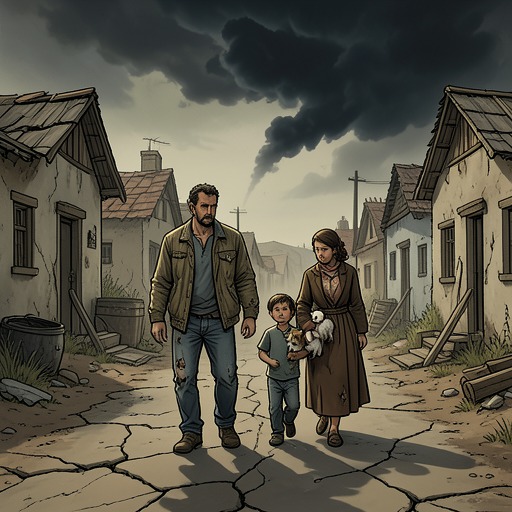
Voices from ChernobylTajikistan appears in these testimonies not as a neutral point on a map but as a homeland made unrecognizable by war. For families who flee, the country remains bound to Dushanbe, relatives left behind, and lives built before the fighting; it is also the place where neighbors and former schoolmates can become enemies. Their departure brings physical safety, but not a simple refuge from loss: they carry the violence, uncertainty, and rupture of belonging with them.
Homeland and the outbreak of violence
The daughter in the K. family testimony identifies the family as coming from Dushanbe, where war has upended ordinary life. She recalls armed men boarding a bus to check passengers’ documents and pulling men off to shoot them outside. One victim, a young man, pleaded that his wife had just given birth and that three small children were waiting at home. The passengers sat silently as the bus continued, hearing gunfire behind them. Her account makes the threat immediate and public: the bus, a vehicle of travel, becomes a place where people witness killings without being able to intervene.
The violence also overturns the daughter’s belief that a large, powerful country could protect its people from another war. She had grown up with assurances that the suffering of the earlier war and the strength of the Soviet military meant that no one would attack again. Instead, people who had once lived together began killing one another. She contrasts this conflict with the war her grandfather had known, describing the new violence as neighbors turning on neighbors, and boys who had attended school together fighting each other. Her account stresses the shock of recognizing familiar social ties inside the violence, rather than confronting an enemy wholly outside the community.
Divisions within a shared community
The conflict she describes is not presented as a simple division between separate peoples. Pamir and Kulyab Tajiks are fighting one another despite sharing a faith and the same Koran. She recalls going to a city square to understand a protest, asking an older man what its participants opposed. The explanation she received was that the Parliament had been identified as a bad person. The square then emptied, and shooting began. The sudden shift from public gathering to gunfire makes the political turmoil difficult to interpret from the perspective of someone trying to understand events as they unfold.
Her husband faces the conflict through a different kind of pressure. He is Tajik and, she says, was expected to go and fight, but he chose to leave rather than kill another Tajik. His refusal does not free him from the war: his brothers remain behind, one has been killed, and his mother and sisters are still there. The family’s departure therefore divides it across a border, preserving the husband’s refusal to take up arms while leaving his loved ones within reach of the conflict.
Even the journey away marks the family as a target. On the Dushanbe train, the windows are broken and the carriage is cold and unheated. People throw rocks and shout at the passengers to leave, calling them occupiers, although the daughter’s husband is Tajik. Their daughter, then in first grade, comes home wondering whether she is Tajik or Russian. The question brings the political division into the child’s understanding of herself: the labels shouted at the train have entered the home, where the family cannot easily explain how a child should belong.
Refuge, displacement, and divided belonging
The daughter’s testimony follows the family from Tajikistan to Belarus, where they settle in Narovlya. She says that she feels safer there because people are no longer playing with guns. Her husband finds work, and they receive a house. Yet safety is not the same as a settled sense of home. She describes the family as having been left without a homeland, and says that Russia does not feel like hers; the homeland in which she was raised was the Soviet Union. The dissolution of that larger political world compounds the loss of the country they have fled.
The arrival of friends from back home shows how drastically ordinary life has changed in Tajikistan. The friends come to Belarus at night and remain at the train station until morning, afraid to leave with their children. In Narovlya they see people walking, laughing, and smoking, and then find butter and cream in a shop. After going without those foods for two years, they buy five bottles of cream and drink them there. The contrast is not offered as a general description of either country; it is a measure of what war has made ordinary provisions and an unafraid walk through town feel like.
A separate account of flight from Tajikistan records another cost of leaving. A traveler going from Dushanbe toward Minsk describes being delayed by officials until a bribe resolves repeated obstacles to transporting the family’s belongings. The container weighs two tons; its contents include clothes, mattresses, a broken refrigerator, and two bags of books. The books are named as works by Chernyshevsky and Sholokhov, objects carried into exile even as the travelers are questioned about what they are taking. This speaker describes the journey as the loss of two homelands at once: Tajikistan and the Soviet Union. Together, these accounts present departure as more than escape from a dangerous place. It is a passage into safety that cannot restore the home, family unity, or political belonging left behind.